
Craps is played with two dice so the possible numbers rolled are 2 through 12. The craps table layout looks confusing because there are many different bets that can be made and because the layout at both ends of the table are exact mirrors of each other. (It is merely duplicated in this manner to allow more players at one table.) However, only one bet is played in basic craps play, and it is placed on only one area of the layout. The rest of the layout can be ignored. Craps play can look confusing and fast-moving because players can place multiple bets on different areas of the layout at the same time. However, craps play can actually be slower than blackjack due to the fact that the dice often have to be rolled multiple times before the outcome is determined.
When you place a basic craps bet (explained below) all you are doing is placing a wager that the person who is rolling the dice will roll the number he needs to win. You're essentially just along for the ride. You are in no way in competition with the person rolling the dice. In fact, you are betting on how lucky they are with the dice. "The house" (the casino), on the other hand, is hoping the person rolling the dice isn't so lucky. This is why you'll often hear a lot of hooting and hollering and find a sense of camaraderie around a craps table. When the person rolling the dice does good, all the players do good.
You have probably noticed that when you are at a casino, the most amount of crowd is by the craps table and not to mention, beautiful women too. If you want to get good at craps, you need to first go through the guide listed on our site and then try them out at an online casino that accepts US players. Once you feel confident there, then head down to a casino and wow the crowd.
The basic bet in craps is the Pass Line bet:
On the Come-Out Roll:
When the series continues....:
If the shooter establishes a point, the series continues and the shooter continues to roll the dice. The object of the game now becomes for the shooter to roll their point number again before they roll a 7.
| This is the most confusing thing to new craps players. Note that rolling a 7 after a point is established is a loser, which is opposite of the 7 being a winner on a come-out roll. Remember this key point and you're a craps player! |
In other words, if a shooter establishes a point, they roll the dice continuously (the series of multiple rolls) until they either roll their point or seven out. If a number other than the point or a 7 are rolled, nothing happens (as far as Pass Line bettors are concerned) and the shooter rolls again.
That's all there is to basic craps play !
Here's an example series:
The shooter throws the dice on a come-out roll, which starts a new series, and a 5 is rolled. (Recall that rolling a 7 or 11 would have been winners and 2, 3, or 12 would have been losers.)
The shooter has established a point of 5.
The shooter throws the dice again and rolls an 8.
Nothing happens for Pass Line bettors.
The shooter throws the dice again and rolls a 3. (Note that rolling a 2, 3, 11, or 12 after a point is established means nothing to Pass Line bettors.)
Nothing happens for Pass Line bettors.
The shooter throws the dice again and rolls a 5.
This is the shooter's point so Pass Line bettors win and the series ends.
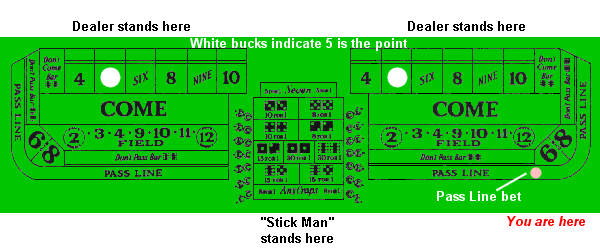
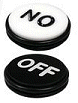 Each dealer has a hockey-puck-looking disk (called a "buck") which is white on one side and black on the other. When a shooter establishes a point, the buck is placed on the point number (on the layout) white side up. When there is no point established (i.e. during a come-out roll), the buck is turned black-side up and set off to the side of the layout.
You can only place a Pass Line bet at the start of a series (on a come-out roll when there is no point established - i.e. when the buck is black-side up and off to the side). However, some casinos may waive this traditional rule and let you put down a Pass Line bet at any time. Ask a dealer.
The same shooter rolls the dice continuously until they "seven out". No matter how many times they roll a "come-out 7 or 11", craps (come-out 2, 3, or 12), or a point, the shooter gives up the dice only after they "seven out" (i.e. roll a 7 when trying to roll a point) or voluntarily opt out. In other words, the same shooter can have multiple "come-out " rolls and make multiple points before they seven out. (A shooter with many come-out rolls is called a "hot shooter" because they have made multiple points - i.e. they didn't throw a 7 while they had points established.)
If you need chips, lay your money down on the layout in front of a dealer. Never try to hand money to a dealer directly. Also, check to make sure the shooter is not about to roll the dice before you put your money down (so you don't interfere with the dice). Most craps tables have a $5 minimum bet level so when you lay your money down, ask the dealer for "nickels" ($5 chips). (Some of the smaller places may have minimum bet levels of $1, $2, or $3.) If the buck is turned white-side up and is on a number (see diagram above), wait for the series to end and then place your bet (chips) on the Pass Line area of the layout directly in front of you. (This is how the dealers know which bet belongs to which player.) Once a Pass Line bet is down it cannot be removed.
Players take turns being the shooter, going from one player to the next in a clockwise direction around the table. You can pass on being a shooter if you wish, but who knows, you could have the hot hand! When it is your turn to be the shooter, the "stick man" pushes four to six dice in front of you. You select two of the dice and he retrieves the remaining ones. Only use one hand when handling the dice. (If you use two hands they fear you may be switching dice and will force you to re-select from new dice.) Throw the dice to the opposite end of the table. The dice must hit the end wall and bounce back in order to be a valid roll. Also, you must have a Pass Line bet down in order to shoot.
Craps offers players some of the best odds in the house. The Pass Line bet only has a house edge of 1.414%. If you put down "double odds" (which you can learn about on the Intermediate page) with your Pass Line bet the house's edge drops to .606%. Compare that to the house edge of 5.3% for roulette and about 1.5% for blackjack (when you use the basic strategy in a multi-deck game).
This all may seem like a lot to digest all at once but once you go through a couple series you'll find it's really easy. A couple things that can help are the free lessons offered by some of the casinos at their actual craps tables (ask a casino employee if and when they offer free craps lessons) and the Hoyle Casino software mentioned on the Gaming page. But be sure to read through our Intermediate Craps Play and Advanced Craps Play pages first so that you can make the most of the casino's lessons and practice software. All three pages are also summarized on a Craps Play Summary page that you can print out and take with you for easy reference or as a refresher.
See the Tips page for information on how to tip the crew at a craps table.
When you're visiting a land based casino, you will often hear loud cheering and excitement from the craps tables. Craps translates surprisingly well online, considering the fact that you lose the social aspect of the game. It's a great way to play due to the fact that you can roll more turns and play more games. Visit online-casinos-canada.ca/craps for a top list of craps casinos in Canada.
To summarize:
Make sure the shooter is not about to throw the dice and put your money down on the table in front of the dealer and ask for "nickels"
If the current shooter has a point established (look for the buck white-side-up on a number) wait for the series to end by the shooter either making their point or rolling a 7
Put your bet down on the Pass Line in front of you
On the come-out roll; 7,11 wins; 2,3,12 loses; 4,5,6,8,9,10 are points
If a point is established; point number before 7 wins; 7 before point number loses
The Optional Odds Bet - A Simple Bet With A Higher Payback
on the Intermediate Craps Play page